

We Need to Talk About Objective Measures
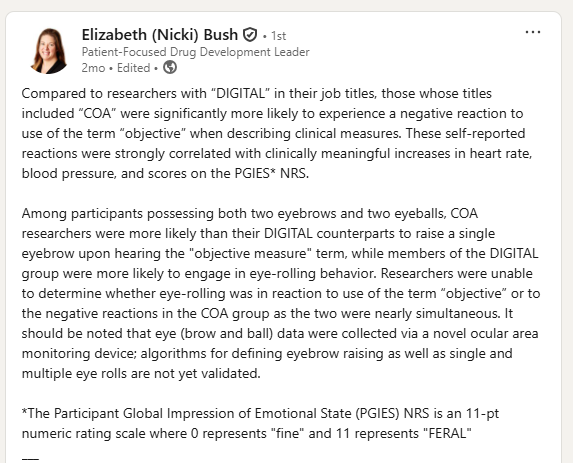
Let’s all make a pact to never call a measure “objective” again!!


One of the most persistent—and consequential—confusions in health measurement is the way we use the words objective and subjective.
This confusion shows up most clearly in discussions of clinical outcomes assessments (COAs), where patient-reported outcomes (PROs) are sometimes dismissed as “subjective,” while clinician-reported outcomes (ClinROs) or performance outcomes (PerfOs) are labeled “objective.” Biomarkers or other laboratory/imaging results are also often referred to as “objective”, with the implications (implicit or explicit) being that this makes them somehow better than PROMs. Observer-reported outcomes (ObsROs) are rarely even included in these discussions because no one knows where to classify them.
At its core, the problem is that objective is often treated as synonymous with unbiased, error-free, or more trustworthy. Subjective, in contrast, is taken to mean noisy, biased, or somehow less scientific.
But this is not how measurement works—psychometrically or practically.
Said another way, “Subjective has come to represent things less meaningful, whereas objective has come to represent things important.” (Rothstein, 2008)
What “objective” actually means (and what it doesn’t)
Unfortunately, the adjective ‘objective’ has multiple, overlapping definitions that can all be applied to measurement.
Per Merriam Webster, objective is defined as (1) “being outside of the mind and independent of it” (ISBN13: 9780877796985).
And
(2) “Expressing or dealing with facts or conditions as perceived without distortion by personal feelings, prejudices, or interpretations”
And
(3) “Of a test: limited to choices of fixed alternatives and reducing subjective factors to a minimum.”
AND
(4) “Of a symptom of disease: perceptible to persons other than the affected individual.”
A stopwatch recording time to complete a task is often called objective because two observers using the same rules will obtain the same value (aligns with definitions #1 and #2). Two thermometers assessing a patients’ internal temperature should obtain the same value.
But objectivity does not mean:
no measurement error
no bias
no assumptions
no interpretation
Anyone who has been timed for a race or had a fever (all of us!) knows that error is baked into these measurements. The time it takes for a person to recognize the sound of the start gun and press the timer, or the reliability of where the thermometer is placed in a patients’ mouth or ear are just 2 examples that influence the numerical value that is ultimately assigned.
Every measurement is embedded in a system of rules: what to observe, how to score it, when to measure it, and how to interpret it. Following these rules or deviating from them introduces error and bias regardless of whether the assessor is a clinician, a device, a test, or a patient.
Calling a measure “objective” does not make it immune to poor reliability, threats to validity, or systematic bias.
To illustrate this point, here are two quotes that use different definitions of “objective”. One set of authors claims that PRO’s are not objective, while the other says they are. Neither is wrong, per say, but you’ll notice how quickly the terms become unhelpful.
PRO’s are not objective: “When clinical trials involve conditions in which there is no objective outcome measurement, such as the degree of morbidity or biomarkers for symptoms, and in which outcomes can only be observed subjectively to the patient in terms of impact, PROs can be used as primary outcome measures.” Weldring & Smith, 2015
The authors are using the definitions 1 and 2 of “objective” with some flavors of definition 4 - the authors recommend that PROs can be used when symptoms are not perceptible to persons other than the patient.
PRO’s are objective: “The validated patient outcome questionnaire is not a ‘subjective’ opinion but an ‘objective’ evaluation that quantifies the patient’s pain, function or severity of disease as perceived by the patient. Assuming the PROM has been well constructed, it provides a robust measurement and therefore should be recognised as an objective tool.” Hamilton, Giesinger, & Giesinger, 2018
The authors here are clearly using definition 3 (‘of a test’) - the authors point out that that the PROs are a set of questions that have been standardized along with a fixed set of choices.
These two quotes make it clear that the term “objective” is not helpful at all in describing what matters about a measurement tool.
Clinician-reported and performance measures are not error-free
ClinROs and PerfOs are sometimes assumed to be superior because they appear more “objective”, meaning that someone else other than the patient is able to perceive the symptoms of a disease (definition #4). However, these measures are shaped by human judgment at multiple points:
Clinicians must rate patient behavior, symptoms, or interpret test results during short clinical visits.
Performance tasks depend on what the original developers thought they were measuring (validity), participants’ understanding of instructions, practice effects, and testing context.
Scoring can be applied inconsistently across raters or settings - meaning that these assessments are actually passing through someone’s mind (definition #1) - just not the patients’.
A clinician’s global assessment, for example, can be influenced by previous experiences with the patient or knowledge of treatment assignment. A performance measure can disadvantage individuals with comorbidities, fatigue, or cultural differences unrelated to the construct of interest. The accuracy of biomarkers can be influenced by the process of data collection and analysis. Imaging results can have error and inconsistencies due to how they are conducted and how they are interpreted.
None of this makes these measures “bad.” It makes them measures—with strengths, limitations, and error that must be understood and managed.
Subjective does not mean unimportant (or unscientific)
Per Merriam Webster, subjective is defined as “of, relating to, or arising within one’s self or mind” (ISBN13: 9780877796985) or “arising out of or identified by means of one’s perception of one’s own states and processes”. Patient-reported outcomes are often described as subjective because they capture internal states: pain, fatigue, emotional distress, quality of life. These constructs cannot be directly observed by anyone other than the patient.
They are absolutely subjective.
But that does not make them less real, less relevant, or less measurable.
If the goal of treatment is to reduce pain, improve function, or enhance well-being, then the patient’s experience is the construct. It is the gold standard. No clinician observation or performance task can substitute for how a patient experiences their symptoms in daily life.

The mistake we see is assuming subjectivity invalidates rigor.
Well-developed PRO measures:
Are grounded in explicit conceptual models
Show sufficient evidence of reliability, validity, and responsiveness within relevant contexts of use
Acknowledge and quantify measurement error
Provide score interpretation guidelines
In other words, they follow the same scientific principles as any other outcome measure or variable.
All measurement has error—and pretending otherwise is wrong.
This is not an argument against ClinROs, or PerfOs, biomarkers, laboratory values, or imaging results. It is an argument against sloppy language and unacknowledged assumptions.
The real scientific task is not to eliminate subjectivity—an impossible goal—but to understand, measure, and communicate uncertainty clearly, regardless of who is doing the reporting.
A better way forward
Instead of pointing out whether a measure (or ANY variable we are using) is objective or subjective, we should ask:
Is this outcome relevant?
Is the way that we are measuring it rigorous and fit for purpose?
Do we understand sources of error and bias?
Can we interpret scores in a way that supports decision-making?
When we frame the conversation this way, patient-reported outcomes stop being seen as liabilities to manage and start being recognized as essential evidence—especially when the goal of care is to improve how patients feel and function.
Takeaways
When PROMs are dismissed as “subjective,” the implication is often that clinician or performance measures are neutral arbiters of truth. This creates a false hierarchy that privileges certain perspectives while masking limitations in measurement.
All clinical outcomes assessments have a level of subjectivity.
All clinical outcomes assessments have some error and bias.
Let’s stop using objective and subjective to classify COAs and signal ‘better’ or ‘worse’. Rather, we need to focus on what is relevant/important to measure and how much anticipated bias and error is generated with each type of COA and choose a COA that way.